Surface & Decollete
What are surface piercings?
Surface piercings pierce a flat area of skin, with both the entry and exit points lying on the same skin plane. Unlike conventional piercings, which pass through a natural skin fold, cartilage or mucous membrane, the piercing channel of surface piercings runs directly beneath the skin surface. This makes them particularly versatile in placement, but also requires special technique and jewellery forms.
At XS Piercing Basel, we exclusively use specially shaped surface bars for this type of piercing. These L-shaped or stepped jewellery pieces reduce the pressure on the piercing channel and thus significantly minimise the rejection risk compared to conventional straight barbells.
Popular placements
Decollete
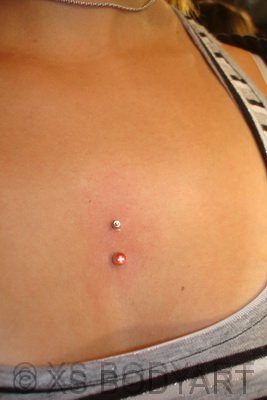
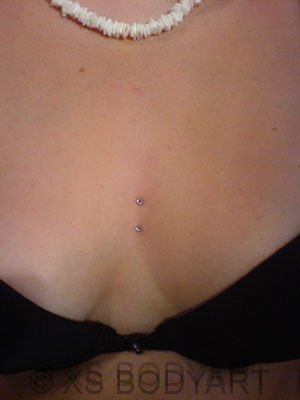
The decollete piercing sits on the sternum, usually centrally in the neckline. It is a particularly elegant eye-catcher with strapless tops and dresses. The placement can be horizontal or vertical and is individually adapted to your neckline and body shape. The decollete is one of the most popular locations for surface piercings, as the skin here is relatively stable.
Nape
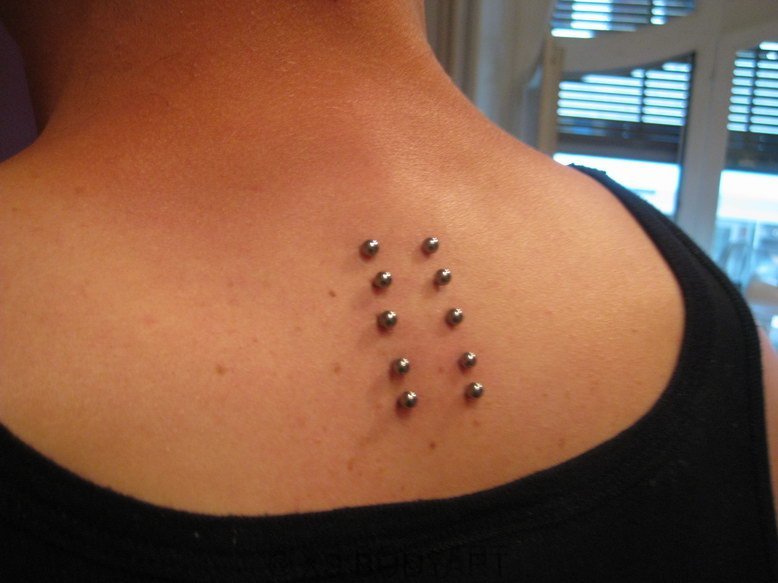
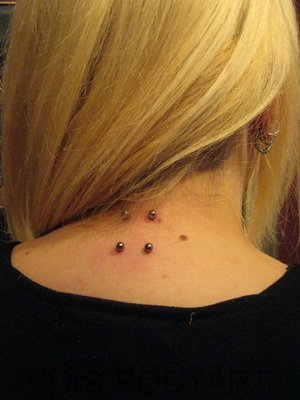
The nape piercing sits in the neck area, usually horizontally on the back of the neck. It is particularly visible with updos or short hairstyles and creates a surprising effect. The nape offers good conditions for a long-lasting surface piercing due to the firmer tissue.
Wrist
A surface piercing on the wrist can be placed on the upper or lower side. It looks like a permanent piece of jewellery and is an alternative to bracelets or watches. Since the wrist is subject to constant movement, particularly careful placement and care are required here.
Other locations
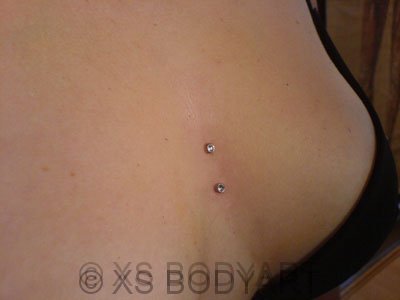
In principle, surface piercings can be placed on almost any flat body location. Other popular positions include the hip area (hip piercing), the temples, the area below the collarbone (anti-eyebrow) or even on the fingers. During the consultation, we discuss which locations are best suited to your individual anatomy and lifestyle.
Technique & jewellery
The key to a long-lasting surface piercing lies in the right technique and the appropriate jewellery. At XS Piercing Basel, we focus on the following points:
- • Surface bars: Special stepped bars made from titanium, with ends angled at right angles upward. This means no pressure is exerted on the piercing channel, significantly reducing the rejection risk.
- • Correct depth: The piercing must sit deep enough to capture sufficient tissue, but not so deep that it affects muscles or deeper structures. The perfect balance is crucial.
- • Appropriate length: The surface bar must exactly match the distance between entry and exit point. Too much or too little play can cause migration.
Risks & rejection
Surface piercings generally have a higher rejection risk than piercings through cartilage or mucous membrane. The body can recognise the jewellery as a foreign body and slowly push it toward the skin surface (migration). This is a natural process that can occur with all surface piercings. The following factors influence longevity:
- • Placement at locations with little movement (decollete, nape) lasts longer than at heavily stressed locations (wrist, hip)
- • Clothing that rubs against the piercing can accelerate rejection
- • Catching on objects or clothing is one of the most common reasons for complications
- • Individual healing ability and skin condition play a major role
Honest advice
We advise you honestly and realistically about the chances of success of a surface piercing at your desired location. Not every body location is equally suitable, and in some cases we recommend a microdermal as a more long-lasting alternative. Your satisfaction and the health of your skin are our top priority.
Healing & care
Surface piercings generally take somewhat longer to heal than many other piercing types. Allow 8 to 16 weeks, depending on placement and individual healing.
- • Clean twice daily with sterile saline solution.
- • Choose clothing that does not rub against or catch on the piercing.
- • Do not touch the piercing unnecessarily or put it under pressure.
- • If signs of migration appear (jewellery appears closer to the surface), come to us immediately.
- • Limit sports and physical activities that stress the affected area in the first weeks.
Gallery
Book Your Appointment
Ready for your new piercing? Book an appointment at XS Piercing Basel now.
Book Your Appointment